Master of Public Administration Executive Track
Elevate your career in the public or nonprofit sector with a flexible, top-ranked MPA program designed for working professionals.
Why Choose UConn
UConn’s 36-credit Master of Public Administration (MPA) Executive Track — also known as the Fellows Program — prepares students for leadership roles as public managers and policy decision-makers. You’ll join a small, supportive cohort of peers who share your commitment to government and nonprofit leadership.
Available at UConn Hartford and UConn Stamford
One great program, two convenient locations
#1 in Connecticut for Public Affairs Programs
U.S. News & World Report
Connecticut’s Only NASPAA-Accredited School
Network of Schools of Public Policy, Affairs, and Administration
Program at a Glance
- Credits: 36 total credits
- Tuition: $1,000 per credit (2025–26 academic year)
- Duration: Complete in just two calendar years
- Start Terms: Fall or Spring
- Locations: UConn Hartford or UConn Stamford
- Cohort Model: Join a small, supportive group of working professionals.
- Flexible Course Sequence: You can take electives during summer sessions, alongside core courses, or after you complete your core requirements.


Study in Hartford or Stamford
The MPA Executive Track offers the same rigorous, NASPAA-accredited curriculum at two UConn campuses, making it accessible to professionals statewide.
- UConn Hartford, located in the heart of Connecticut’s capital, offers direct access to state agencies, the legislature, policy organizations, and a network of public and nonprofit leaders.
- UConn Stamford, located in one of the state’s most economically vibrant cities, connects students to opportunities with top companies, nonprofit organizations, and civic, educational, and community agencies.
Who Should Apply
The Fellows Program is for professionals currently employed in the public or nonprofit sectors, as well as individuals seeking to transition into public service-related roles. Applicants should have a minimum of five years of relevant professional experience, or at least three years in a decision-making role, and must hold a bachelor’s degree from an accredited institution. An undergraduate GPA of 3.0 is required, unless extraordinary circumstances apply.
Prospective applicants with eligibility questions are encouraged to contact publicpolicy@uconn.edu.
Faculty
UConn School of Public Policy professors are experts in public management, policy analysis, and program evaluation research.
They have established research programs in education policy; state and local fiscal policy; social policy; leadership and public management; diversity policy; and the demand for public services. They also cross disciplinary boundaries by collaborating with scholars in political science, psychological sciences, sociology, and other fields in the College of Liberal Arts and Sciences and beyond.


Advising and Career Coaching
Advisors meet with students from the initial point of admission to map-out a program of study that meets their career goals. We provide fellows with access to our network which features exclusive job postings, post-graduation fellowships, and other career and professional development resources/opportunities.
Fellows are also encouraged to utilize our Alumni Mentoring Network for professional guidance during their graduate studies to help prepare for their future careers.
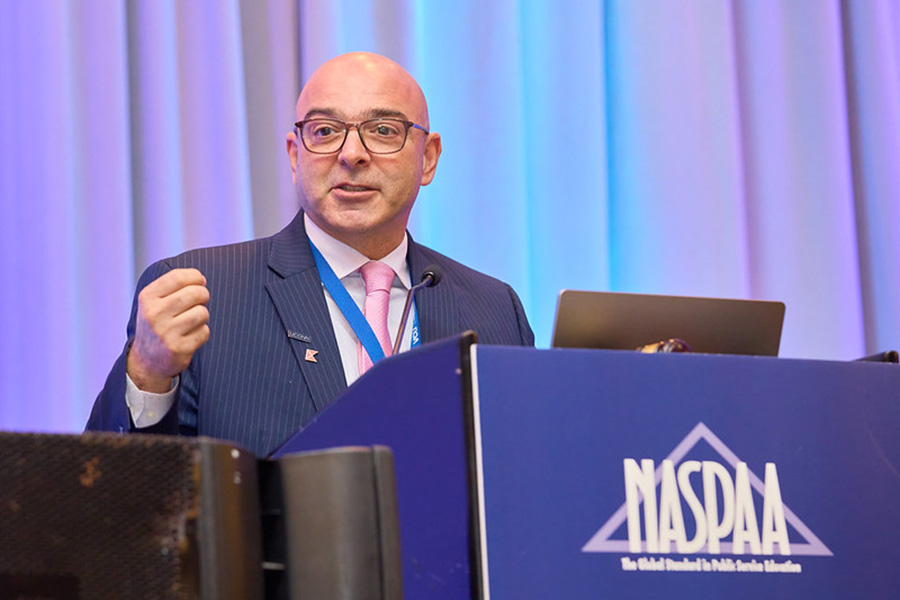
NASPAA Accreditation
Our program is the only MPA program in Connecticut that is accredited by the Network of Schools of Public Policy, Affairs, and Administration (NASPAA). NASPAA accreditation verifies that your degree meets the standards of the public service education field, laying the foundation for your future success.

Outcomes and Careers
Alumni of UConn’s MPA Executive Track are leaders in nonprofit organizations and in government at the national, state, and local levels. Their successes contribute to our school’s national reputation and our ability to attract high-caliber students from around the world.
By earning your MPA through UConn's School of Public Policy, you'll also join our network of talented alumni who in turn mentor current students.
“I met amazing, intelligent, innovative people from different sectors. We did profound work with real clients in a reasonable schedule. The Fellows Program had it all!”
Mary McCallister '22 MPA
State of CT Planning Analyst

Academics
Program Requirements
Our 36-credit MPA curriculum is designed to prepare students for the important responsibility of becoming public managers and policy decision-makers. The program develops the skills needed to diagnose problems, collect and analyze information, choose among policy alternatives, communicate findings, implement programs, and manage change.
The executive track follows a cohort-model. The core courses (listed below) will be designed for the executive cohort. The executive experience courses are designed to meet the pedagogical, intellectual, and professional needs of the fellows without compromising the MPA learning outcomes and course quality.
The program is designed to be completed in two years. All students will have the opportunity to complete the core courses in two years and they may choose to complete the electives during the summer, during the regular semester while taking the core classes, or after they complete those classes.
Core Courses
Students must take the following courses:
- PP 5340. Introduction to Public Policy and Management
- PP 5345. Project Management in the Public Sector
- PP 5361. Theory and Management of Public Organizations
- PP 5364. Public Finance and Budgeting
- PP 5365. Human Resource Management
- PP 5370. Applied Research Design
- PP 5375. Economic Analysis for Public Administration
- PP 5376. Applied Quantitative Methods
As you consider how to select your electives, you may choose to cluster them or select a range of electives that allow you to be a generalist. Below are some ways students have clustered in the past. We offer these as a suggestion (subject to availability).
Executive Leadership
- PP 5366. Executive Leadership
- PP 5325. Labor-Management Relations, Negotiation, and Contract Management
- PP 5302. Professional Seminar
Law and Public Policy
- PP 5304. Public Policy, Diversity, and Inclusion
- PP 5363. Local Government Management and Leadership
- PP 5329. Nonprofit Advocacy, Government Relations, and Law
- Law 7600. Administrative Law
- Other courses from the School of Law
Nonprofit Management
- PP 5319. Program Development
- PP 5328. Business Functions of Nonprofit Organizations
- PP 5324. Grant Writing and Government Contracting
- PP 5323. Leading and Governing Nonprofits
- PP 5329. Nonprofit Advocacy, Government Relations, and Law
- PP 5336. Fund Development and Nonprofit Sustainability
Public Financial Management
- PP 5373. Budgeting in Public Service Organizations
- PP 5318. Financial Management for Public Organizations
- PP 5317. Capital Finance and Budgeting
- PP 5326. Public Investment Management
- PP 5374. Topics in Financial Management
Public Policy
- PP 5347. Applied Policy Issues
- PP 5314. Casual Program Evaluation
- PP 5342. Policy Analysis
State and Local Government Management
- PP 5363. Local Government Management and Leadership (required)
- PP 5325. Labor-Management Relations, Negotiation, and Contract Management
- PP 5317. Capital Finance and Budgeting
- PP 5349. Public Procurement and Contracting
- PP 5368. Performance Management and Accountability
- PP 5350. Urban and Regional Policy
Urban Planning
- PP 5348. Urban Planning Principles and Methods
- PP 5363. Local Government Management and Leadership
- PP 5317. Capital Finance and Budgeting
- PP 5350. Urban and Regional Policy
- Other courses from GEOG and LAW
Sample Course Sequence
Below is a model course of study for the UConn MPA executive track program. You can learn more about our courses on our course descriptions page.
Year 1
Year 1 Fall
- PP 5340. Introduction to Public Policy and Management
- PP 5375. Economic Analysis for Public Policy and Management
Total Credits = 6
Year 1 Spring
- PP 5361. Theory and Management of Public Service Organizations
- PP 5364. Public Finance and Budgeting
Total Credits = 6
Year 1 Summer
- Elective
- Elective
Total Credits = 6
Year 2
Year 2 Fall
- PP 5376. Applied Quantitative Methods
- PP 5370. Applied Research Design
Total Credits = 6
Year 2 Spring
- PP 5365. Human Resource Management
- PP 5345. Project Management in the Public Sector
Total Credits = 6
Year 2 Summer
- Elective
- Elective
Total Credits = 6
Total Program Credits = 36
*Electives may be taken during year 1 and/or year 2 for a May graduation
Admissions
Students apply to the UConn MPA program via the UConn Graduate School’s online application.
Contact Us
For more information about the UConn MPA program, please contact:
Outreach Coordinator, School of Public Policy
Application Deadlines
Fall
Priority decision: Feb. 15
Extended Deadline: June 7th
Spring
Final Deadline: Nov. 1