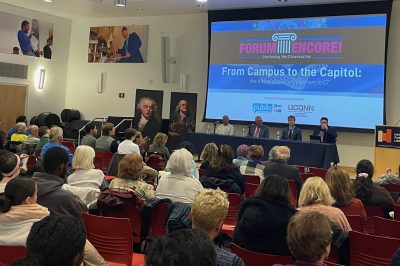
School of Public Policy Director Angie Eikenberry welcomed attendees and then took a seat in the audience, watching proudly as one of SPP’s Fast-Track MPA students, UConn junior Ryan Engel, joined the panel of speakers on stage.
To Engels’ right: Secretary of State Stephanie Thomas and former Senate Minority Leader Len Fasano, who now serves on the Connecticut Sentencing Commission. To Engels’ left: moderator Frankie Graziano, host of the Wheelhouse on Connecticut Public.
 Engels “held his own” among his fellow panelists with far more experience and recognition, said SPP student Georgia LoPresti. “At a young age, he’s already doing so much. It’s encouraging for other students to see.”
The free community discussion, titled “From Campus to the Capitol: The Future of Civic Engagement in Connecticut,” was held on Tuesday, February 3rd, at the Hartford Public Library. It was a Forum “Encore!” event, designed to continue the conversation of the initial program and the SPP/IMRP simulcast of On Democracy and the Future of the Parties: Pete Buttigieg in Conversation with Jonah Goldberg.
In front of a full room, including many UConn Hartford students, panelists focused on the challenges and opportunities of civic engagement in Connecticut and the role students and communities play in shaping public life.
Engels, a political science major, recently completed an internship with the Institute for Municipal and Regional Policy (IMRP), where he worked with Associate Director Ken Barone, who also serves as project manager for the Connecticut Racial Profiling Prohibition Project (CTRP3). Part of Engels’ work involved collecting and organizing data from Inspector General Use of Force Reports to help inform State’s Attorneys and IMRP on police use of force statewide. He was selected to participate in the Forum Encore event given his early involvement in and passion for local and student government.
In addition to his work with IMRP, Engels was recently elected as a Zoning Commissioner in his hometown of Westbrook where he also serves as Chairman of the Sustainability Committee. As a freshman at UConn, he founded the Connecticut Youth Political Advocacy Center (CYPAC) from his dorm room. The organization is a nonpartisan nonprofit dedicated to promoting civic engagement and youth participation at the state and local levels of government. Engels has also served as a senator in the UConn Storrs Undergraduate Student Government and as Executive Vice President of College Democrats of Connecticut.
Read more in IMRP’s: Intern Spotlight: 10 Questions with Ryan Engels
IMRP Director and School of Public Policy adjunct faculty member Andrew Clark brought students from his Public Policy 1001 course to attend the discussion, reinforcing the program’s focus on connecting classroom learning with real-world civic engagement.
During the conversation, Secretary Thomas described civic engagement broadly, defining it as anything from everyday actions like “not throwing trash out your window, picking it up instead,” to more formal participation such as running for public office.
Engels acknowledged that sharing the stage with long-serving Connecticut leaders was initially intimidating. Still, he emphasized that there are no prerequisites for making a difference. “I tell other young people and students interested in getting involved, you belong in these spaces. If you have the motivation and dedication to the causes that you feel strongly about, you can make an impact – no matter your age.”
If you have the motivation and dedication to the causes that you feel strongly about, you can make an impact – no matter your age.
Thomas echoed that sentiment, stressing the importance of encouraging young people to exercise agency now rather than waiting until later in life. Fasano added that many traditional entry points into politics lack younger participation. He noted that the average age of town committee members he has worked with is 68.
“Town committees are the epicenter for people who want to go into politics,” Fasano said. “That’s a place you can plug into and the quickest place you can make a change, but I don’t see a lot of younger people getting on these committees and putting the time in. Then it’s tough to not put the time in and complain later.”
Thomas also emphasized that while many issues feel national in scope, change often happens locally.“Unless you know where to intersect in government and put your energies, you can get frustrated, and that’s where civic education comes in,” she said. She suggested everyone visit The Power of Civics free online training available on the ct.gov website.
Fasano reflected on what he sees as a growing disconnect between younger generations and government. “Seems to me that there might be more disenfranchisement and disconnect with the younger generation,” he said. “They have to change that energy to a positive energy. Being upset about it doesn’t create change. Having input and having a conversation with their politicians to have a dialogue to effectuate change does.”
“Young people are disillusioned,” Engels agreed. “Young people too often rely on social media for their engagement. We can get into the habit of seeing each other as usernames rather than having human conversations. Getting back to having conversations like these is important.”
Engels highlighted an upcoming debate between UConn College Democrats and UConn College Republicans at the Dodd Center for Human Rights on Thursday, February 5th as a sign of constructive engagement. “Young people can engage in respectful civil discourse,” he said.
To close the discussion, Graziano asked panelists to share a small but meaningful step audience members could take to become more civically engaged. Engels offered advice tailored to different generations. For students, he encouraged joining youth advisory boards aligned with their interests, noting that these spaces benefit from youth voices. For older community members, he suggested mentoring students, describing the impact as potentially life changing.
—————
To learn more about SPP’s Fast-Track program, click HERE.
To host an SPP intern, or for other ways to give back as an SPP alumni, click HERE.