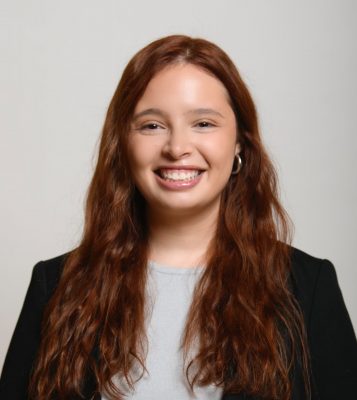
From STEM to Service: Paula Norato (MPA ‘22) on the Path to Public Administration
When Paula Norato looks back on her path to UConn and public administration, she laughs a little at how unconventional it was. Raised in Urbana-Champaign, Illinois, she applied to only three colleges – Illinois, Yale, and UConn. After her father joined UConn’s Mechanical Engineering faculty, the family moved East just as she was finishing high school.
“It was all very last-minute and unplanned,” she admits. “I didn’t have a clear vision of where I was going. The present felt hard, so picturing the future was even harder.”
Those present challenges included the onset of the pandemic just months before her May 2020 graduation. Her STEM scholarship kept her tied to the sciences and her cell biology major, but it was coursework in the political sciences and Latino Studies that most interested her.
“My last two years, I had some space in my schedule to take classes purely because I was interested in them,” Paula recalls. “Those were the classes that fed my soul, honestly.”
A Last-Minute Pivot to Public Administration
Like many students graduating during the pandemic, Paula faced her post-collegiate years with uncertainty. A friend mentioned UConn’s MPA program, and it caught her attention immediately.
“I applied at the absolute last minute, in April. I wasn’t sure I’d get in. But I did.”
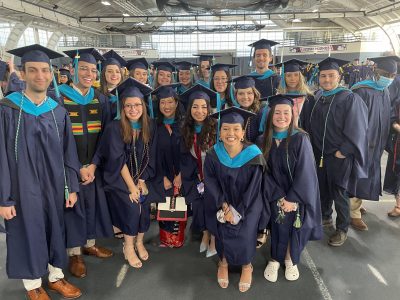
She enrolled in fall 2020, when the program was still fully online except for one intensive course held across several masked, in-person weekends.
“You could tell people so desperately wanted to engage with each other. I was incredibly grateful for that class,” she says. “It gave us the community we were missing.”
Discovering the Value of an MPA
Paula found herself surprised by how much she connected with the MPA curriculum, especially the quantitative courses.
“No one had ever shown me how math applies to everyday life,” she explains. “Seeing how you can predict patterns and understand where we’re going – that was groundbreaking to me. I still have all my notes.”
She gained real-world experience at the same time as a graduate assistant in UConn’s Innovation House learning community where she taught a class to first- and second-year students.
“My undergrad experience wasn’t what I wanted for a long time. To be able to guide other students through obstacles and tough times and help them see undergrad through a new lens – that meant so much to me.”
Through her IPP placement with Partners for Educational Leadership, she saw how statewide support systems operate behind the scenes to support schools and began to understand the broader impact of public service.
The MPA opened my eyes to the different paths you can take to help people. That’s one of my biggest motivators: I want to help people in some way or form.
“I hadn’t considered how an MPA could be applied in real life until I saw what faculty and alumni were doing,” she admits. “The MPA opened my eyes to the different paths you can take to help people. That’s one of my biggest motivators: I want to help people in some way or form.”
The sense of School community was equally meaningful. “Even when we were remote or hybrid, I never felt alone,” Paula says. “You’re supported every step of the way. Once you’re in, you’re part of a community and network, not just across the state but across New England. It opens so many doors.”
Launching a Career in Higher Education and Fundraising
During her final semester of the program while still completing classes, working as a GA, and finishing her IPP, Paula landed her first full-time job as a Development Assistant in Harvard University’s Alumni Affairs and Development Office. Her earlier undergraduate job with the UConn Foundation’s fundraising events team gave her the footing she needed
She challenged her routine with a contract position fundraising for a Massachusetts library. The front-line fundraising experience prepared her to move into a full-time fundraising and communications role with the Phillips Brooks House Association, a student-led nonprofit within Harvard.
“I loved teaching student leaders how to fundraise, write press releases, and handle media relations,” she says. “Working with students is a theme for me – it’s so fulfilling.”
Seeking better work-life balance, she returned in 2024 to Harvard’s Alumni Affairs and Development Office in a new role supporting graduate school alumni. Her days now include meeting with alumni and donors, managing volunteer committees, coordinating communications, and collaborating with fundraising colleagues across the graduate schools.
Once you’re in, you’re part of a community and network, not just across the state but across New England. It opens so many doors.
A Commitment to Helping Others
For Paula, the thread tying all her work together is simple: people.
“The MPA helped me not only with long-term, strategic thinking and relationship-building, but also with the confidence to show up for myself in all areas,” Paula says. “At the end of the day, we have to care about other people. I’m grateful that I get to support students and theirresearch. My support of their studies is going to go on to help many more people.”
She smiled as she reflected on her early studies in STEM and her transition to public service. “Working in a lab is solitary work. I like interactions and building relationships and community. Everyone in my family is in some way or form teaching someone else.”