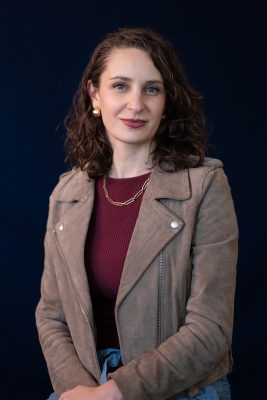
A Year of Transition: 10 Questions with Assistant Research Professor Lydia Wileden
1. Hi Lydia – it’s been a little more than a year since you moved from the Midwest to Connecticut. What drew you to the School of Public Policy and the Institute for Municipal and Regional Policy?
Even while I was getting my PhD, I was never sure becoming a professor was my end goal. I have a background in local and federal government and assumed my post-PhD life would be in applied policy research, likely at a think tank or within government itself. At the same time, I had become fairly immersed in the academic research world, which is a hard world to quit. When I saw this opportunity with the Institute for Municipal and Regional Policy, it felt like a perfect place to bridge the applied and academic worlds. IMRP cares deeply about producing research on policy programs that are digestible, timely, and rigorous. My colleagues like to push the boundaries of traditional policy prescriptions, question why things are the way they are, and dream up alternatives and how system change can come about. And we do that all with the support of a world-class university. In short, this position with IMRP means I lucked out by finding the best of all worlds.
2. What have been some of the highlights of the first year?
What a whirlwind year! When I talk to people about the last 365 days, I’ve been describing it in three phases: 1. Getting here; 2. Being here; and 3. Figuring out what’s next. Each phase has some major highlights.
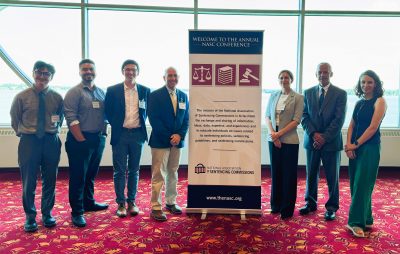
In the first phase (Sept – Dec of 2024), I was commuting an hour each way to work, while also looking for a house, learning UConn and IMRP’s systems, experiencing Connecticut, and getting ready to have a baby. The highlights of that phase included being greeted kindly by my new colleagues, finding a landing place for my family, taking on my first IMRP projects, and staying mostly sane.
In the second phase (Jan – May 2025), I taught for the first time in the School of Public Policy’s Survey Research Certificate Program, wrapped up some lingering projects from my postdoc, took ownership of several IMRP research requests, and enjoyed the sweet newborn phase with my son. Obviously, the newborn snuggles were a highlight! I was also really proud of the survey methods course I revamped and I made exciting progress on data access for a project on Domestic Violence I’m leading for the Sentencing Commission.
This past summer and fall, phase three, I felt like I started to get my legs back under me. I’ve dug deeper on policing and sentencing research reports, I’ve applied for grant funds to launch new projects on juvenile justice, and I’ve experienced first-hand what correctional facilities in CT are like through conversations with inmates and correctional officers,. At the same time, I’ve also finalized a book chapter and published an academic article on neighborhood mapping, and I am constantly working to develop ideas for new research projects.
3. You’ve had some interesting assignments in your career thus far. What does public service mean to you? Why do you feel called to serve?
I believe strongly in the power and potential of people. Especially in these fractious times, too many policy conversations seem to me to be about how do we exclude others, write off communities, distinguish between what is ours and what is theirs. To me, that’s not only misguided but a poor use of fiscal, emotional, and human capital. From informal settlements outside Cape Town, South Africa to tony summer getaways in the Adirondacks, from fancy conference rooms in Washington D.C. to program rooms in Cheshire Correctional Institution, the people that I have met in my career – even those I disagree with – are trying to chart a path to live happy, meaningful lives. My calling to public service centers on trying to figure out how to help them succeed, amplifying our collective potential, and removing or overcoming the barriers circumstance sometimes puts in the way.
4. You have a particular interest in urban policy and neighborhood change. What opportunities do you see here in Hartford?
I am fascinated by Hartford. Growing up in Western MA, Hartford was my hometown airport, so I felt like I knew the city even though I’d spent no time here. Since coming to UConn, I’ve made Hartford my home and I’ve stumbled upon some really lovely, dynamic parts of the city while also feeling the frustration of living in a town impacted by long-term disinvestment and financial flight. Connecticut is often characterized by its 169 towns, but my sense is a lot of Capitol Region and Connecticut residents take for granted the importance of Hartford as a political and economic hub. The city makes a lot of life in the state possible and really deserves more support than it receives. Coming from Detroit, I know what large scale blight, vacancy, and revitalization looks like. As I settle in here, I am trying to draw on that experience while also putting Hartford’s small scale into perspective to imagine the city’s future.
5. On that note, tell us about the work you do with NRZs and the development of Neighborhood Revitalization Zones.
Connecticut’s Neighborhood Revitalization Zones were a new-to-me policy. Because IMRP is named in state statute as a member of the NRZ Advisory Board, learning about NRZs and their potential impact was a natural space for me to step into when I arrived. Since last September, I’ve been actively participating in the Advisory Board, including doing a site visit to Bridgeport to see the amazing efforts of the East End NRZ, sitting on the Resources Workgroup to shape how NRZ processes are explained to interested communities, and hosting an event to mark the 30th anniversary of the NRZ legislation. I also took my summer research intern on a field trip to the legislative library to read all the testimony about the NRZ program when it was established back in 1995. I’m hoping to get elected to a spot on my local NRZ’s leadership team this winter.
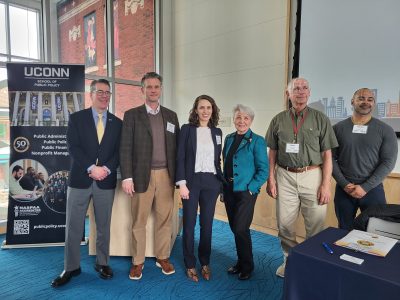
6. The NRZs were among the topics of CT Policy Talks, a series co-sponsored by the School of Public Policy. What were your takeaways as a moderator of some of these conversations?
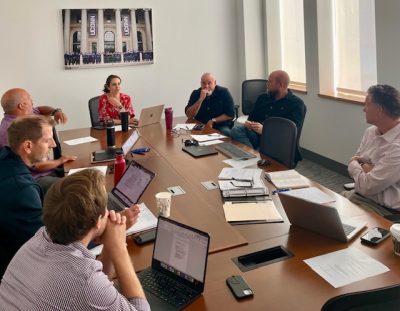
The CT Policy Talks series showed me that Connecticut is full of engaged thinkers. Our NRZ event was standing room only, we had nearly 60 attendees turn out for our conversation on transportation insecurity, and we similarly filled WORK_SPACE in downtown Manchester for our event on Third Places. The events also suggested to me a need for these types of conversations that take an overarching, rather than piecemeal, view of a system. All three conversations highlighted the amazing work by individual NRZs, transportation districts, and local entrepreneurs while also making real the need for more opportunity for peer-to-peer learning so that best practices from one could more easily be implemented in another. NRZs could pool information about how to apply for Community Development Block Grant (CDBG) funds or best practices to provide food at their meetings to enable more residents to attend. Transit districts could exchange innovations on mobile payment systems and route timetables. And communities can share strategies to remove red tape around turning public space – sidewalks, parks, parking lots – into more dynamic social spaces, like Hartford’s Salsa Socials on Pratt Street.
7. What are you currently working on or looking forward to that is exciting or interesting to you?
So many things! One of the great privileges of this position is that I am getting introduced to so many new-to-me topics in the realm of criminal justice at the same time as I build upon my expertise on neighborhood identity and extend that work to Connecticut. In terms of criminal justice work, I have three new projects I am trying to develop, including a longitudinal analysis of police pursuits, a study of geographic disparities in juvenile arrests and detentions across Connecticut, and an examination of correctional officer well-being that builds on the work of IMRP’s International Justice Exchange and our partnership with Amend. In terms of my neighborhoods work, I’ve started talking to both the Connecticut Main Street Center and some local CDCs about how to measure resident attachment, community vitality, and neighborhood identity in Connecticut. I’m excited to see where these projects go!
8. We are excited to announce the class you’ll be offering at the School for the Spring 2026 semester. PP 5350 – Urban & Regional Policy. Tell us about the class and how it came about.
I’m taking this class over from my esteemed colleague, Dr. Robert Wilson, and trying to put my spin on it. National politics get a lot of oxygen, but local policy is where many of the impactful decisions that shape your and my daily lives happen. This is especially true in Connecticut, where the absence of county government and the celebration of local oversight give the state’s 169 towns unusual power. This class is going to look at local (and regional) governments, how they’re structured, how they reflect resident voices, and what that means for some really critical policy areas like housing, policing, education, and more. We’ll use Connecticut as a case study, talk about how opportunities and inequities get created locally, and be open about what is or is not missing due to the strength of local rule.
9. The class will meet here on the UConn Hartford campus on Wednesday evenings after work. Who is the ideal student to enroll? And, what advice do you have for UConn students interested in public policy?
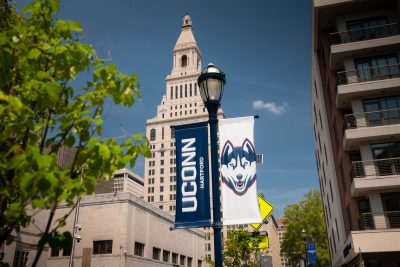 Anyone who finds themselves in Hartford on a Wednesday night! I’monly sort of kidding. The class should be really interesting to anyone who works in, works for, or lives in this state. I am excited to peel back some layers and think critically about how our communities got to where they are and what creative paths forward are. A benefit of focusing on local politics is that I hope students will come away with a sense of how they can make a meaningful difference, and why that is important.
10. Why should students choose UConn as a place to study public policy and administration? What makes this school special?
It’s often taken for granted how much policy that shapes our lived experience happens at the state and local level. Our homes, schools, neighborhoods, streets, restaurants, parks, etc. are regulated and funded locally. UConn is an incredible place to learn this first-hand — Not only are we a stone throw from the capitol building, but you would be hard-pressed to go into any government or government-adjacent entity and not find a UConn SPP alum. It’s a strength of being in a small state that physical and relational proximity is so strong. Not only does that tight knit network make SPP the place to be, but it also means that the contributions of SPP have made a meaningful impact on Connecticut residents.