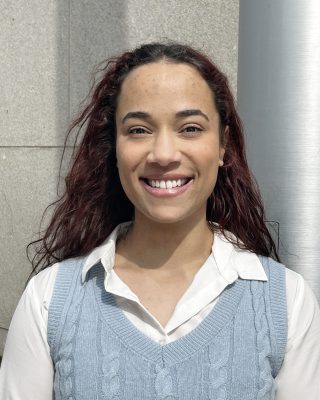
 SPP Student Spotlight: Bridget Foley-Johnson
Two Degrees = Double the Impact
In a single semester at UConn’s School of Public Policy, Bridget Foley-Johnson has already found herself in rooms with Connecticut Governor Ned Lamont, state commissioners, agency leaders, and other policymakers shaping Connecticut’s future.
“I’ve met so many people doing impactful work,” Bridget says of the networking opportunities. “It’s clear the program is intentional about connecting students to opportunities in government.”
For Bridget, those moments are both exciting and strategic. They reflect why she chose UConn: a place where learning extends beyond the classroom and into the networks and systems where real decisions are made.
After graduating from Springfield College in 2021 with a degree in psychology and a minor in biology, the West Hartford resident went to work at Hartford HealthCare, supporting adults with substance use disorders and other mental health challenges.
“I set out to help individuals,” she said. “But during my three years at Hartford HealthCare, I also got a look at the policy side of medicine and how decisions made behind the scenes affect clinicians, patients, and entire systems.”
That realization, along with a desire to “make a difference at a population level,” led her to explore advanced degrees in public policy and social work. She’s now pursuing both a Master of Social Work and a Master of Public Administration through UConn’s School of Social Work and School of Public Policy.
I see how intertwined the two fields are. It made sense to study them together, especially with the internship opportunities and the range of career paths it opens up.

“I could see how intertwined the two fields are,” she said. “It made sense to study them together, especially with the internship opportunities and the range of career paths it opens up.”
Separately, each program requires two years of study but pursuing them jointly allows students to complete requirements for both degrees in three years instead of four.
“Typically, students in this joint degree program start with a majority of public policy classes in their first year, switch to a majority of social work classes in their second year, and then complete a combination of coursework in the third year,” explained Catherine Guarino, SPP’s Director of Student and Academic Affairs.
Guarino notes that in addition to the combined MPA/MSW program, UConn and the School of Public Policy offer several dual or joint degrees, including:
- MPP or MPA and JD (dual degree)
- MPP or MPA with MA and MA in Latina/o & Latin America Studies (joint degree)
- MPA and MSW (joint degree)
- MPP and MS in Quantitative Economics (joint degree)
“It felt like a strategic place to be if you want to work in public service,” Bridget says of her decision to pursue the joint degrees. She was also drawn to UConn by the strong presence of its graduates in local, state, and federal government roles.
Coursework in both programs has helped her build a solid foundation. Classes like Analysis of Social Welfare Policy have given her a deeper understanding of the history of social work in the U.S., while Public Finance and Budgeting and Introduction to Public Policy have strengthened her analytical and writing skills.
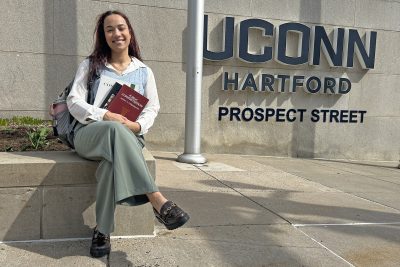
Through SPP’s Internship and Professional Practice program (IPP), Bridget is gaining hands-on experience with the Connecticut Department of Developmental Services (DDS), where she works on employment and day services, supportive housing, and technology initiatives for adults with intellectual disabilities. One of her key projects involves creating accessible materials to explain a new housing program to the individuals it serves.
“This internship has really connected both social work and policy for me. I’ve seen the importance of having a ‘seat at the table’ to impact decisions,” Bridget said.
As an example, she points to an executive meeting for a supportive housing project that included participants from the Self-Advocates Committee, a group of individuals with developmental disabilities who receive services. Their contributions helped shape the development of the document.
“The inclusion of this population highlighted key areas that need to be more accessible, which is important in providing individuals with information they can understand to make informed decisions about their lives,” she concludes.
That’s what motivates me, knowing I can contribute in a way that benefits my community and beyond.
Bridget will have the opportunity to complete a second internship through the School of Social Work and expects to graduate with both degrees in May of 2027. After, she hopes to build a career in state or local government, focusing on preventative healthcare and harm reduction, particularly for adolescents facing mental health and substance use challenges.
Beyond the classroom, Bridget is passionate about strengthening connections between the School of Public Policy and the School of Social Work and the shared emphasis on service roles.
“It’s the one thing we all share, being part of the public,” she said. “Any impact we make in that space affects everyone. That’s what motivates me, knowing I can contribute in a way that benefits my community and beyond.”
—
Students interested in pursuing a joint or dual degree program through the School of Public Policy can email Catherine.Guarino@uconn.edu for more information.